Sarasota sits along one of the most beautiful stretches of Florida's Gulf Coast, and the salt-laden breeze that drifts off the water is part of what makes living here so special. But that same marine air is relentlessly corrosive to the aluminum, steel, and nylon hardware that keeps your sliding glass doors operating smoothly. Understanding how salt air damages specific components — and how quickly it can happen — helps homeowners in Sarasota, Siesta Key, Venice, and coastal Osprey stay ahead of expensive repairs.
Why Salt Air Is So Damaging to Door Hardware
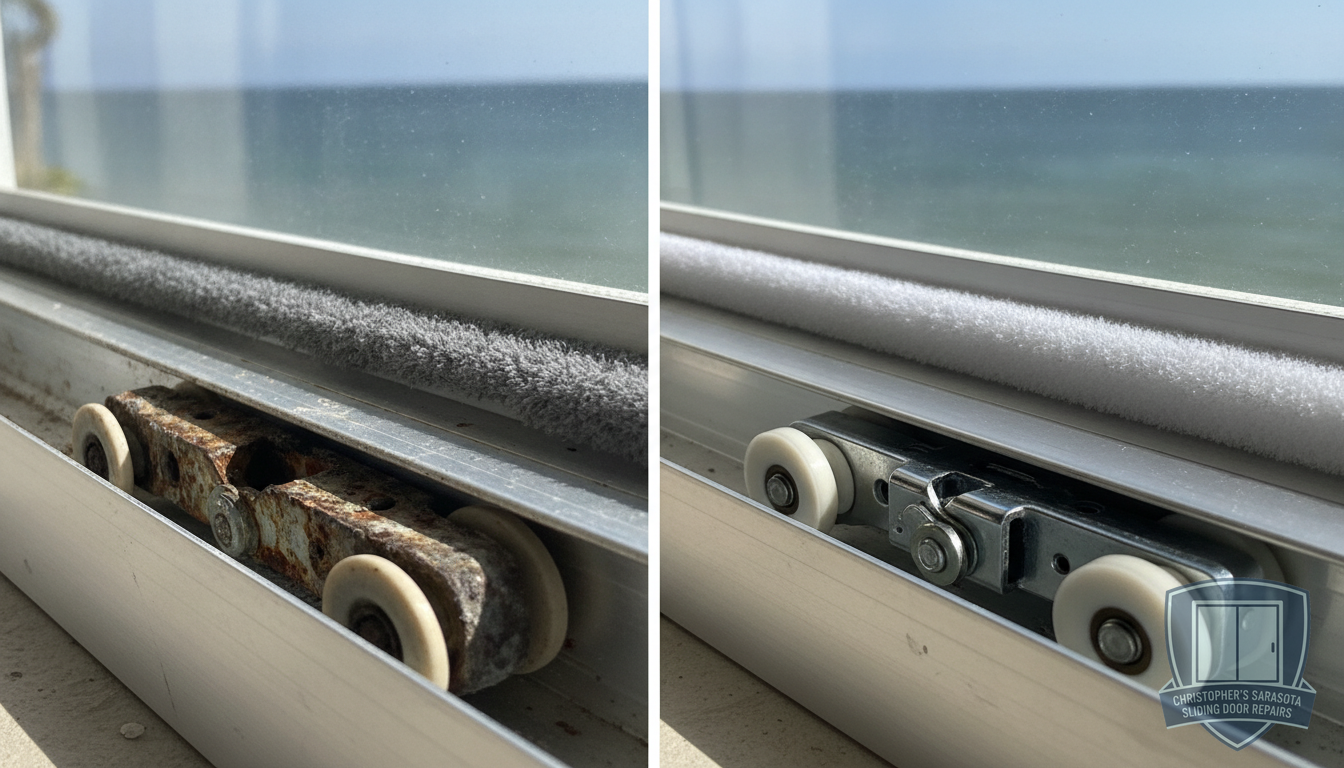
Salt particles carried in coastal air settle on every exposed surface, including the metal and nylon components of your sliding door system. When moisture — from humidity, afternoon rain, or condensation — contacts those salt deposits, an electrochemical corrosion process begins. Aluminum oxidizes, steel rusts, nylon becomes brittle from UV and chemical exposure, and lubricants wash away or degrade far faster than in inland environments.
The problem is compounded by Sarasota's fine quartz sand, which blows in from Gulf beaches and accumulates in door tracks and roller mechanisms. Sand acts as a grinding compound, accelerating mechanical wear on every moving part. The combination of salt corrosion and abrasive sand is particularly harsh on the bottom track, where debris collects and is continuously driven into roller assemblies with every pass of the door.
The Most Vulnerable Components
Rollers
The rollers beneath your sliding door bear the panel's full weight — often 100 to 200 pounds for a large glass panel — while turning thousands of times per year. Nylon roller wheels become brittle and crack from UV exposure and chemical attack. Steel ball bearings corrode and seize. When rollers fail in a coastal environment like Sarasota, the progression from "slightly stiff" to "completely unusable" can happen within a single season.
Our sliding door roller replacement service uses corrosion-resistant assemblies appropriate for coastal conditions, and we inspect the bottom rail for secondary damage every time. You can also read more about roller-specific warning signs in our guide on when rollers need replacing.
Bottom Track
The aluminum bottom track sits at floor level, making it the catch basin for every grain of salt, sand, and moisture that enters through the door opening. Over time, the track surface pits and corrodes, creating rough patches that cause rollers to skip and jump. In severe cases, the track profile deforms enough that the door can no longer travel its full width.
Our sliding door track repair and replacement service addresses everything from minor surface corrosion that can be cleaned and smoothed to fully collapsed track sections that require a new aluminum or stainless-steel track cut to the precise length of your opening.
Lock Hardware
The hook-style latch mechanisms and mortise locks on sliding patio doors contain small steel springs and cams that are highly susceptible to salt-air corrosion. A lock that functioned perfectly when the door was installed may fail within a few years in a coastal home as internal springs weaken and cams corrode into fixed positions. This is especially common in Siesta Key and bayfront properties where humidity is consistently high.
Our sliding door lock repair and replacement service covers the full range of latch assemblies, mortise locks, and auxiliary security devices, with inventory stocked to match the major impact door brands common throughout Sarasota County.
Weatherstripping
The pile and vinyl bulb weatherstripping around your sliding door is the barrier between your conditioned interior and the outside world. Coastal UV exposure degrades pile fibers quickly, and the constant expansion and contraction of the door frame in Sarasota's temperature swings causes vinyl bulb seals to compress permanently. Once weatherstripping fails, salt-laden humid air flows freely around the door frame — accelerating corrosion of the hardware behind it and raising your cooling costs.
Replacing weatherstripping proactively every four to six years in a coastal environment is one of the most cost-effective maintenance steps a Sarasota homeowner can take. Learn more about our weatherstripping replacement service.
Glass Seals
The thermal seal of an insulated glass unit — the airtight bond that keeps argon gas between the two panes — can be compromised by the same expansion-contraction stress that affects weatherstripping. When the seal fails, moisture enters between the panes and creates the persistent fogging or milky haze that no amount of cleaning will resolve. A fogged glass unit is also a significantly less effective insulator, meaning your air conditioner works harder every day.
Our sliding door glass and seal replacement service sources tempered, laminated, and low-E glass units cut to your door's exact dimensions, including impact-rated panels for homes in Sarasota County's wind-borne debris regions.
A Practical Maintenance Schedule for Coastal Sarasota Homes
- Monthly: Vacuum the bottom track to remove accumulated sand and debris. Wipe down the track with a damp cloth.
- Every 6 months: Apply a silicone-based lubricant (not WD-40, which attracts dirt) to the track and roller adjustment screws. Inspect weatherstripping for visible compression or gaps.
- Annually: Have a professional inspect rollers, track condition, lock function, and weatherstripping. Catching minor wear early consistently costs less than addressing failures after they cascade into larger problems.
- Before hurricane season: Verify that locks engage fully, that the door closes and seals completely, and that all weatherstripping is intact. A door that doesn't close flush or lock reliably is a wind-load liability.
When to Call a Professional
Any of the following warrant a service call rather than a DIY attempt: a door that has jumped its track, a lock that no longer engages, visible rust or corrosion on the track, fogged glass between the panes, or a door that requires significant effort to open or close. These symptoms indicate component failure that requires correct parts and proper adjustment — not just lubrication.
Christopher's Sarasota Sliding Door Repairs serves homeowners throughout Sarasota, Siesta Key, Venice, North Port, Bradenton, and Osprey, seven days a week from 8 AM to 6 PM. Call (941) 231-6728 or email [email protected] to schedule a comprehensive door inspection or any of our repair services.
Confirm Availability
Call +19412316728 or fill out our online form for a free, no-obligation quote.
Request Free Quote